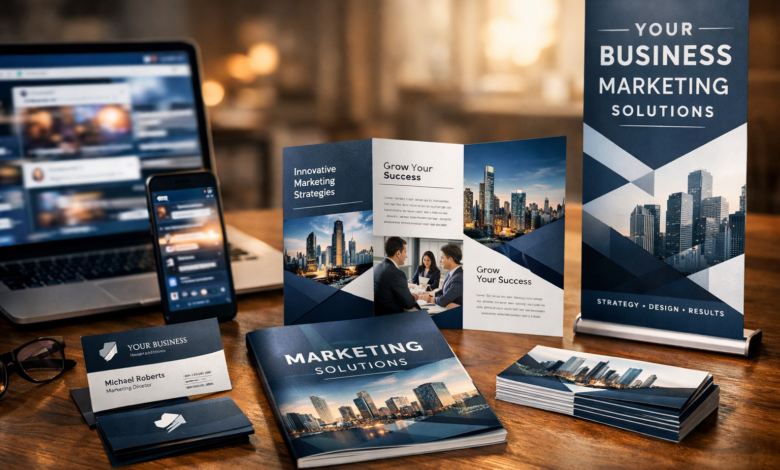
Digital marketing dominates headlines. Algorithms change weekly. Ads disappear in seconds. Feeds refresh endlessly. And yet, walk into any successful retail store, trade show booth, or corporate office and you’ll see something that hasn’t disappeared: printed materials.
A well-crafted brochure still commands attention. A bold banner still stops people in their tracks. A business card still seals introductions with a handshake. Physical marketing pieces linger. They sit on desks. They stay on countertops. They travel in briefcases.
In fact, 75% of consumers say they trust print advertising more than digital ads. Trust drives action. Action drives revenue. This is where professional commercial printing becomes strategic, not decorative.
Companies like Inkr printing technology demonstrate how powerful this can be. Specializing in both large- and small-format commercial printing services, including business cards, brochures, trifold brochures, banners, billboards, and booklets, they help organizations produce high-quality, customized marketing materials that strengthen brand visibility and support effective event promotion. From compact networking cards to large-scale outdoor graphics, they provide the physical tools businesses need to be seen and remembered.
In this guide, we’ll explore:
- Why commercial printing still matters in 2026
- The data behind print marketing ROI
- Which materials increase brand visibility fastest
- How modern printing technology evolved
- And how to choose the right assets for your next campaign
Let’s dig in.
What Is Commercial Printing and Why It Matters in Marketing
Definition of Commercial Printing
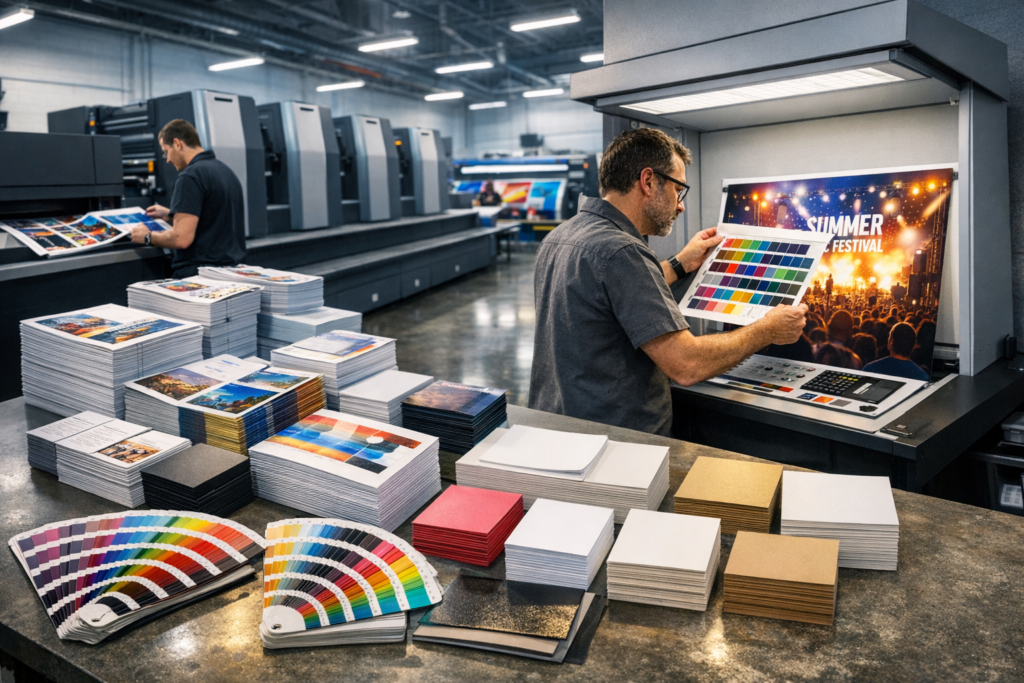
Commercial printing refers to professional printing services produced at scale for business use. Unlike home or office printing, commercial printing uses industrial-grade equipment capable of:
- High-resolution color accuracy
- Large-format production
- Specialty finishes
- Bulk printing with consistency
- Variable data personalization
It includes both:
| Category | Examples | Primary Purpose |
|---|---|---|
| Small-Format Printing | Business cards, brochures, booklets, flyers | Direct communication and brand reinforcement |
| Large-Format Printing | Banners, billboards, signage, trade show displays | High-visibility brand awareness |
These materials are part of a broader print marketing strategy. They function as tangible brand assets.
And physical assets influence perception.
The Strategic Role of Printed Marketing Materials
There’s a reason major brands still invest millions in printed collateral. Print creates cognitive impact that screens struggle to replicate.
Research shows print advertising response rates average 4.4%, compared to 0.6% for email campaigns. That gap is not small. It’s dramatic.
Why?
Because print:
- Feels permanent
- Feels credible
- Engages multiple senses
- Faces less competition than digital feeds
Imagine this scenario.
You attend a conference. You collect 20 business cards. One is thick, well-designed, and printed on premium stock. The others are flimsy.
Which company feels more established?
That tactile difference influences trust subconsciously.
Brand visibility is not just about being seen. It’s about being remembered.
Printed marketing materials contribute to:
- Brand recall
- Perceived authority
- Purchase confidence
- Local market recognition
According to industry data, 60% of consumers say printed catalogs help them make purchasing decisions, and many prefer receiving them by mail.
Digital marketing drives awareness. Print reinforces legitimacy.
The strongest brands combine both.
The State of the Commercial Printing Industry
Market Size and Growth Trends
Some assume print is fading. The numbers tell a different story.
The global commercial printing market was valued at approximately $774.5 billion in 2024, with projected growth continuing through 2033.
That scale reflects ongoing demand from:
- Retail brands
- Educational institutions
- Healthcare providers
- Real estate firms
- Event organizers
- Corporate marketing teams
Print is evolving, not disappearing.
Key industry trends include:
- Short-run digital printing
- Sustainable printing materials
- Personalized variable data printing
- High-resolution large-format graphics
- Integration with QR codes and analytics
Digital technology improved production speed. It reduced waste. It allowed cost-effective short runs.
Small businesses can now access professional printing without massive minimum orders.

Adoption by Businesses of All Sizes
Print remains especially important for small and mid-sized businesses.
Data indicates 85% of small businesses consider print marketing a cost-effective local outreach strategy.
Local visibility often depends on:
- Storefront signage
- Event banners
- Direct mail flyers
- Brochures in community spaces
Online ads compete globally. Print competes locally.
That distinction matters.
A well-placed banner outside a community event reaches a highly targeted audience. A billboard near a busy intersection reinforces brand presence daily.
Print also lasts longer than digital impressions. A flyer may stay on a refrigerator for weeks. An Instagram ad vanishes in seconds.
Longevity equals exposure.
Print Marketing Performance: Statistics That Prove It Works
Let’s address the question every marketing manager asks:
“Does print still deliver ROI?”
The answer, backed by data, is yes.
Trust and Consumer Engagement
Trust shapes buying behavior.
Studies show:
- 75% of consumers trust print ads more than digital ads
- 56% consider print advertising more trustworthy than digital formats
Trust reduces friction. Reduced friction increases conversions.
Print also engages attention differently. Screens encourage scrolling. Print encourages pausing.
Consider a direct mail piece versus an email blast. One is tangible. One competes with 100 unread messages.
Which receives more focused attention?
ROI and Response Rates
Direct mail response rates average 4.4%, compared to 0.6% for email campaigns.
That means print can generate over seven times the response rate in certain contexts.
Personalization increases impact further. Data suggests personalized print campaigns can boost response rates by up to 20%.
These figures demonstrate why integrated marketing campaigns still rely on printed collateral.
Print works especially well for:
- Product launches
- Grand openings
- Event promotion
- Real estate listings
- Healthcare announcements
- Educational recruitment
It cuts through digital noise.
Key Printed Materials to Boost Brand Visibility
Not all printed materials serve the same purpose. The format should align with the campaign goal.
Let’s break down the most effective categories.
Business Cards: Small but Powerful
Business cards remain foundational.
They serve as:
- A personal brand extension
- A networking tool
- A first physical impression
Despite digital contact sharing, business cards remain standard at conferences and meetings.
Strong business card printing should consider:
- Paper weight
- Finish (matte, gloss, soft-touch)
- Typography clarity
- Color consistency with brand identity
A poorly printed card undermines credibility. A high-quality card reinforces professionalism instantly.
Brochures and Trifold Brochures
Brochures deliver detailed information in a compact format. They are ideal for:
- Trade shows
- Retail displays
- Medical practices
- Real estate marketing
- Educational institutions
trifold brochures, in particular, balance space and portability. They organize content into digestible panels.
Effective brochure printing includes:
- Clear visual hierarchy
- High-resolution imagery
- Compelling headlines
- Strategic calls to action
Inkr Printing offers trifold brochure printing options that allow customization in paper stock, finishes, and folding style, making them adaptable for diverse industries.
Brochures act as silent sales representatives. They explain. They persuade. They remain.
Banners, Billboards, and Large-Format Printing
Large-format printing creates immediate visibility.
Common use cases include:
- Trade show backdrops
- Retail promotions
- Outdoor advertising
- Community events
- Construction site branding
Large graphics attract attention from a distance. They increase brand recognition through repetition.
Billboards, for example, combine scale with location targeting. They operate continuously without algorithm dependency.
High-resolution large-format printing requires specialized equipment and color calibration. Professional printing services maintain consistency across size variations.
Booklets, Catalogs, and Extended Collateral
Booklets provide depth.
They allow storytelling. They showcase product lines. They outline services clearly.
Industries that benefit most include:
- Manufacturing
- Fashion retail
- Automotive
- Education
- Nonprofits
Catalog-style printing supports purchase decisions. As noted earlier, 60% of consumers find printed catalogs helpful in buying decisions.
Booklets also strengthen perceived authority. Length signals investment. Investment signals seriousness.
How to Choose the Right Materials for Your Campaign
Choosing printed marketing materials should start with strategy, not aesthetics.
Before selecting products, ask:
- What is the campaign objective?
- Who is the audience?
- Where will materials be distributed?
- What action should the reader take?
Here’s a simple alignment guide:
| Campaign Goal | Recommended Print Materials |
|---|---|
| Brand Awareness | Banners, billboards, signage |
| Lead Generation | Brochures, flyers, direct mail |
| Networking | Business cards |
| Product Showcase | Booklets, catalogs |
| Event Promotion | Large-format displays, trifold brochures |
Matching Goals to Print Products
For example:
Launching a retail store? Use:
- Exterior banners
- Window signage
- Direct mail postcards
- In-store brochures
Hosting a corporate seminar? Use:
- Event banners
- Program booklets
- Branded folders
- Business cards
Print becomes powerful when aligned with intent.
Print Quality, Paper, and Finishes
Material choice affects perception.
Consider:
- Matte vs. gloss
- Coated vs. uncoated stock
- Thickness (measured in GSM or lb weight)
- Specialty finishes like embossing or foil
Heavier stock communicates durability. Matte finishes often feel premium. Gloss enhances imagery.
These details influence brand perception more than many marketers realize.
Personalization for Higher Impact
Variable data printing allows customized messaging within bulk runs.
Examples:
- Personalized names on mailers
- Location-based messaging
- Industry-specific brochure variations
Personalization increases engagement. It signals relevance.
Data supports this. Personalized print can increase response rates significantly.
Modern commercial printing services make personalization accessible even for mid-sized campaigns.
Integrating Print with Digital Marketing
Print and digital are not rivals. They are teammates.
The smartest brands combine both. They use printed marketing materials to drive online engagement and use digital platforms to amplify physical campaigns.
This integration strengthens brand visibility across channels.
QR Codes, PURLs, and Bridging Offline to Online
A printed brochure no longer has to stop at paper.
Modern commercial printing services allow you to incorporate:
- QR codes
- Personalized URLs (PURLs)
- Custom landing page links
- Tracking codes
- NFC tags (in premium formats)
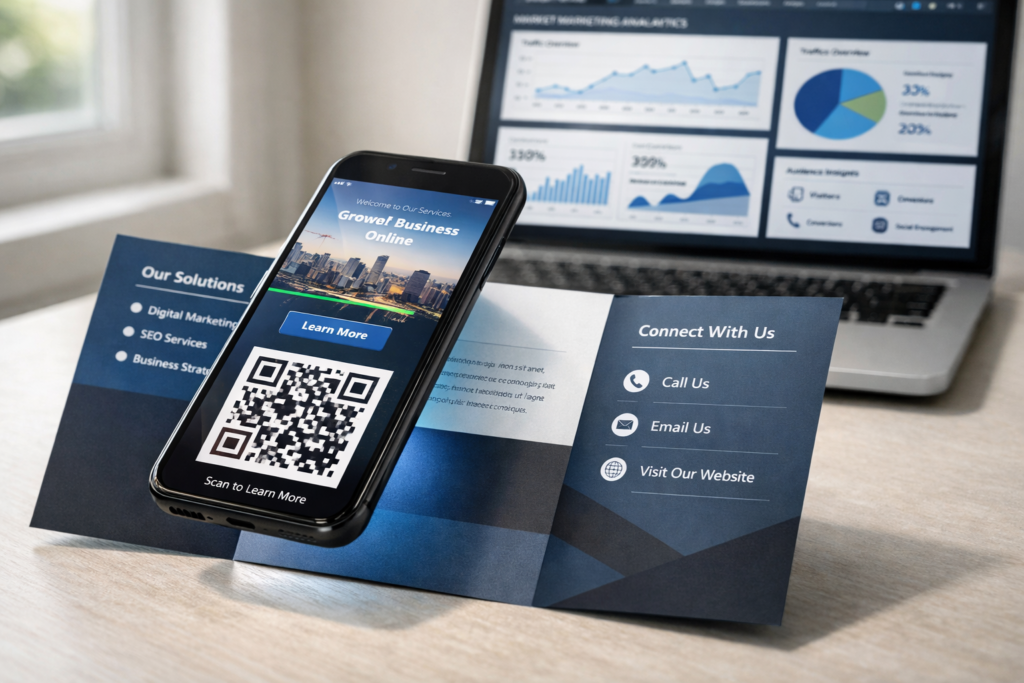
A well-placed QR code on a trifold brochure can:
- Direct readers to a product demo
- Capture email leads
- Trigger appointment bookings
- Track engagement by campaign source
This transforms static print into measurable marketing.
For example:
A real estate agency distributes 2,000 brochures with QR codes linking to a property video. The landing page tracks visits. Now the agency knows exactly how many leads came from print.
That is performance-based marketing.
And it works because print captures attention first.
Remember, print response rates average 4.4% compared to 0.6% for email campaigns. If those responses feed into a digital funnel, the return compounds.
Analytics and Tracking Print Performance
One myth persists: “Print can’t be measured.”
That used to be true. It no longer is.
Today you can track print performance using:
- Custom URLs
- Discount codes
- Dedicated phone numbers
- QR scan analytics
- CRM source tracking
Pair that with marketing automation tools, and you gain clear attribution data.
A practical example:
A fitness studio launches a local campaign using:
- Window banners
- Direct mail postcards
- Flyers at community centers
Each printed asset contains a different QR code.
Results show:
- 120 scans from postcards
- 40 scans from flyers
- 10 scans from window signage
Now the studio knows which materials generate real engagement.
Data informs the next print run.
This hybrid strategy creates integrated marketing campaigns that balance visibility and analytics.
Best Practices & Mistakes to Avoid
Printed materials can elevate your brand. Or they can weaken it.
Quality matters. Messaging matters. Placement matters.
Let’s break down what works — and what doesn’t.
Design and Messaging Tips
Strong printed marketing materials follow simple principles:
1. Clarity Over Clutter
Avoid cramming too much information into one layout.
Use:
- White space
- Clear headlines
- Short paragraphs
- Strong calls to action
A brochure that overwhelms readers loses them.
2. Visual Hierarchy
Guide the eye.
Use:
- Larger font for key messages
- Bold headings
- Consistent branding
- Strategic imagery
People scan before they read. Structure supports scanning.
3. Consistent Brand Identity
Every printed piece should reflect:
- Brand colors
- Typography
- Logo placement
- Tone of voice
Inconsistency weakens recognition.
Remember, brand visibility depends on repetition.
4. High-Resolution Graphics
Large-format printing requires sharp imagery.
Pixelated banners damage credibility instantly.
Professional commercial printing services calibrate color and resolution for different formats.
Common Print Marketing Pitfalls
Avoid these frequent mistakes:
- Printing low quantities to save money but reprinting later at higher cost
- Choosing the cheapest paper stock regardless of brand positioning
- Ignoring distribution strategy
- Failing to track performance
- Overloading materials with text
Print is powerful. But poor execution wastes budget.
One more critical insight:
75% of consumers trust print advertising more than digital formats.
That trust only applies when materials look professional.
A cheap flyer suggests a cheap business.
Why Partner with a Professional Printer Like Inkr Printing
Commercial printing is technical. It involves equipment calibration, color management, material selection, and finishing expertise.
Working with an experienced provider reduces costly errors.

Expertise in Large and Small Format Printing
Inkr Printing offers both:
- Small-format printing
- Business cards
- Brochures
- Trifold brochures
- Booklets
- Large-format printing
- Banners
- Billboards
- Event signage
- Display graphics
That range allows businesses to maintain visual consistency across materials.
For example:
A brand launching a new product can coordinate:
- Business cards for sales reps
- Trifold brochures for distribution
- Booklets for detailed specs
- Large-format banners for events
All printed with aligned colors, finishes, and typography.
Consistency builds authority.
Quality and Customization
Modern marketing materials demand customization.
Options may include:
- Matte or gloss finishes
- Heavyweight card stock
- Fold variations
- Specialty coatings
- Variable data printing
Customization increases engagement. Data shows personalized print campaigns can increase response rates by up to 20%.
That performance difference matters.
Real-World Scenario
Imagine a nonprofit organizing a fundraising gala.
They require:
- Invitations
- Event programs
- Stage banners
- Sponsor signage
Each piece must align visually.
A single professional printer simplifies coordination. It reduces delays. It protects brand image.
And it supports effective event promotion.
Commercial Printing and Brand Visibility: A Strategic Framework
Let’s simplify everything into a framework you can use immediately.
Step 1: Define Visibility Goals
Are you aiming for:
- Local awareness?
- National exposure?
- Event engagement?
- Product education?
Clarity shapes format selection.
Step 2: Select Appropriate Print Assets
| Objective | Recommended Asset | Why It Works |
|---|---|---|
| High street visibility | Banner or billboard | Large-scale repetition |
| Detailed product education | Booklet or brochure | Structured information |
| Networking | Business cards | Personal interaction |
| Community outreach | Flyers and direct mail | Local targeting |
Step 3: Integrate Tracking
Add:
- QR codes
- Custom URLs
- Offer codes
Measure performance.
Step 4: Review and Refine
Use campaign data to adjust:
- Distribution areas
- Messaging
- Format mix
This process turns commercial printing into a repeatable growth engine.
Frequently Asked Questions (FAQ)
What is the difference between commercial printing and regular printing?
Commercial printing uses professional equipment for high-volume, high-quality production. It supports business marketing materials such as brochures, banners, booklets, and signage.
Does print marketing still work in 2026?
Yes. The global commercial printing market was valued at approximately $774.5 billion in 2024, with continued growth projected. Consumer trust in print remains strong.
What printed materials generate the highest ROI?
Direct mail and personalized print campaigns often generate strong response rates. Print response averages 4.4% compared to 0.6% for email.
How can print support digital marketing?
By using QR codes, personalized URLs, and tracking codes, printed marketing materials can drive measurable online engagement.
Final Thoughts: Print Is Tangible Power
Marketing trends shift constantly. Platforms rise and fall. Algorithms change overnight.
Paper does not.
A well-designed brochure still persuades. A banner still commands attention. A business card still opens doors.
Print supports brand visibility because it occupies physical space in a customer’s life.
And customers still respond.
Businesses that combine:
- Strategic commercial printing services
- High-quality custom marketing materials
- Data tracking integration
- Consistent branding
gain a competitive edge.
Companies like Inkr Printing help organizations execute that strategy effectively, offering expertise across large- and small-format printing services — from business cards and trifold brochures to banners, billboards, and booklets.
The result?
Stronger brand recognition. Higher trust. Measurable engagement.
Digital may spark attention.
Print makes it stick.