In discussions surrounding private aviation, attention is often directed toward comfort, exclusivity, and convenience. While these attributes undeniably contribute to the appeal of private air travel, they do not fully explain why business aviation continues to play a critical role in corporate mobility strategies worldwide.
For executives, entrepreneurs, investors, and leadership teams, the most significant benefit of business aviation is not luxury—it is productivity.
In today’s highly competitive business environment, time has become one of the most valuable organizational resources. Decision-making cycles are accelerating, markets are increasingly interconnected, and leadership teams are expected to operate with greater speed and agility than ever before. Under these conditions, travel can either support productivity or undermine it.
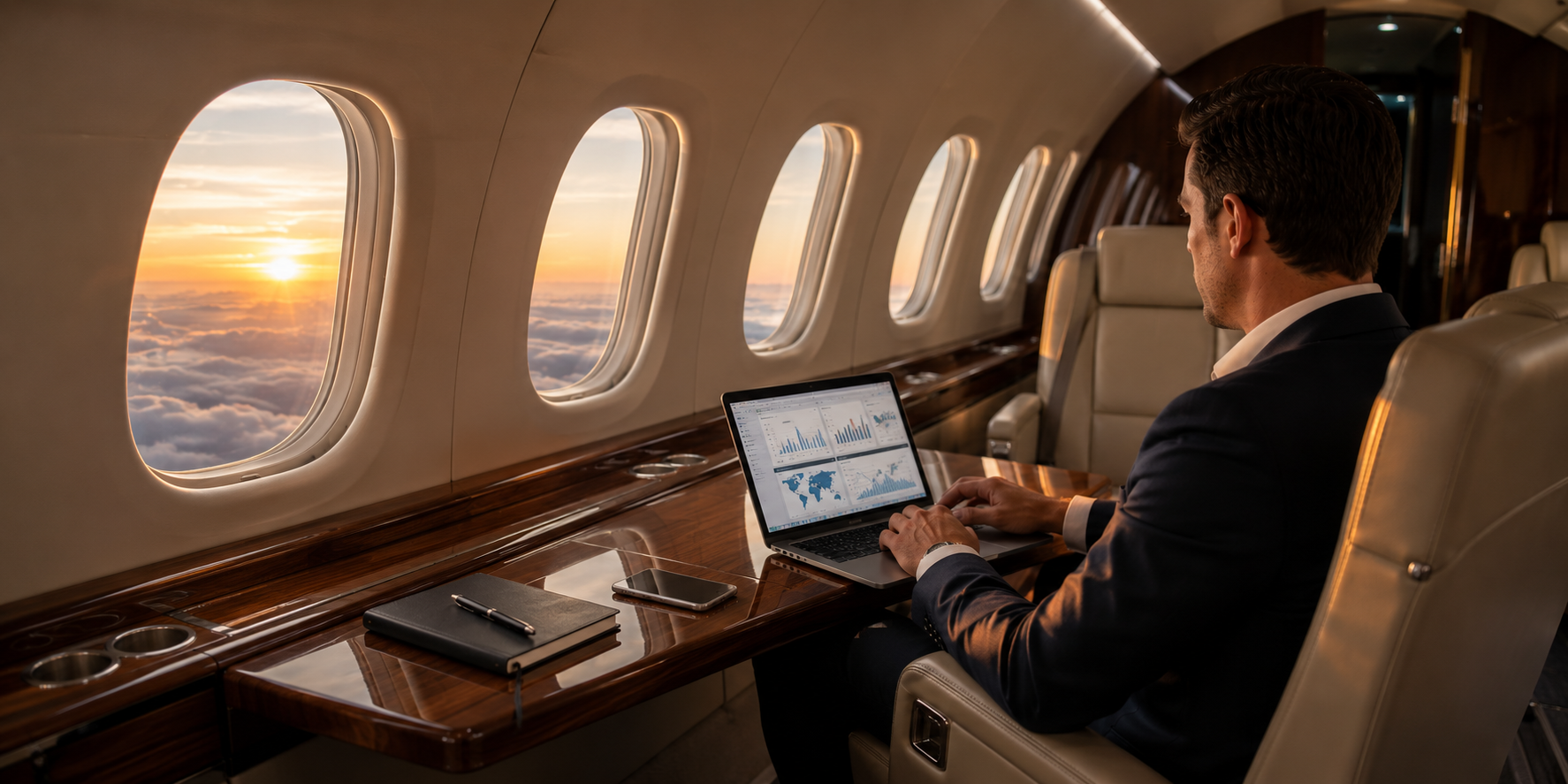
Traditional commercial travel often introduces inefficiencies that consume valuable time, disrupt workflows, and limit organizational responsiveness. Business aviation, by contrast, is designed to reduce these barriers and transform travel from a necessary interruption into a productive extension of the working day.
Understanding the productivity advantage of business aviation provides valuable insight into why many organizations view private air travel not as a luxury expense, but as a strategic investment in efficiency, performance, and growth.
Productivity and the Modern Business Environment

The nature of work has changed dramatically over the past several decades.
Organizations increasingly operate across multiple regions, time zones, and markets. Leadership teams frequently oversee geographically dispersed operations, while executives are expected to engage clients, partners, investors, and stakeholders with unprecedented speed.
At the same time, competitive pressures have intensified.
Companies that can make decisions faster, respond more effectively to opportunities, and deploy resources more efficiently often gain significant advantages over slower-moving competitors.
In this environment, productivity extends beyond traditional measures of employee output. It encompasses the ability of organizations to maximize the effectiveness of their most valuable personnel.
Business aviation contributes directly to this objective by improving how executives and teams move, communicate, and work while traveling.
The Hidden Productivity Costs of Commercial Air Travel

When evaluating travel options, many organizations focus primarily on direct transportation costs.
However, commercial air travel often involves substantial indirect productivity costs that are rarely included in traditional analyses.
A typical commercial journey may require:
- Early airport arrival
- Security screening procedures
- Terminal waiting periods
- Boarding delays
- Flight connections
- Baggage collection
- Extended ground transportation
These activities consume hours that could otherwise be dedicated to business priorities.
Moreover, the disruption extends beyond lost time. Frequent interruptions, crowded environments, and unpredictable schedules can diminish concentration and reduce the effectiveness of work performed before and after travel.
For senior executives, whose decisions may influence entire organizations, these productivity losses can be particularly significant.
The true cost of travel therefore includes not only transportation expenses but also the economic value of time that cannot be used effectively.
Transforming Travel Time into Productive Time

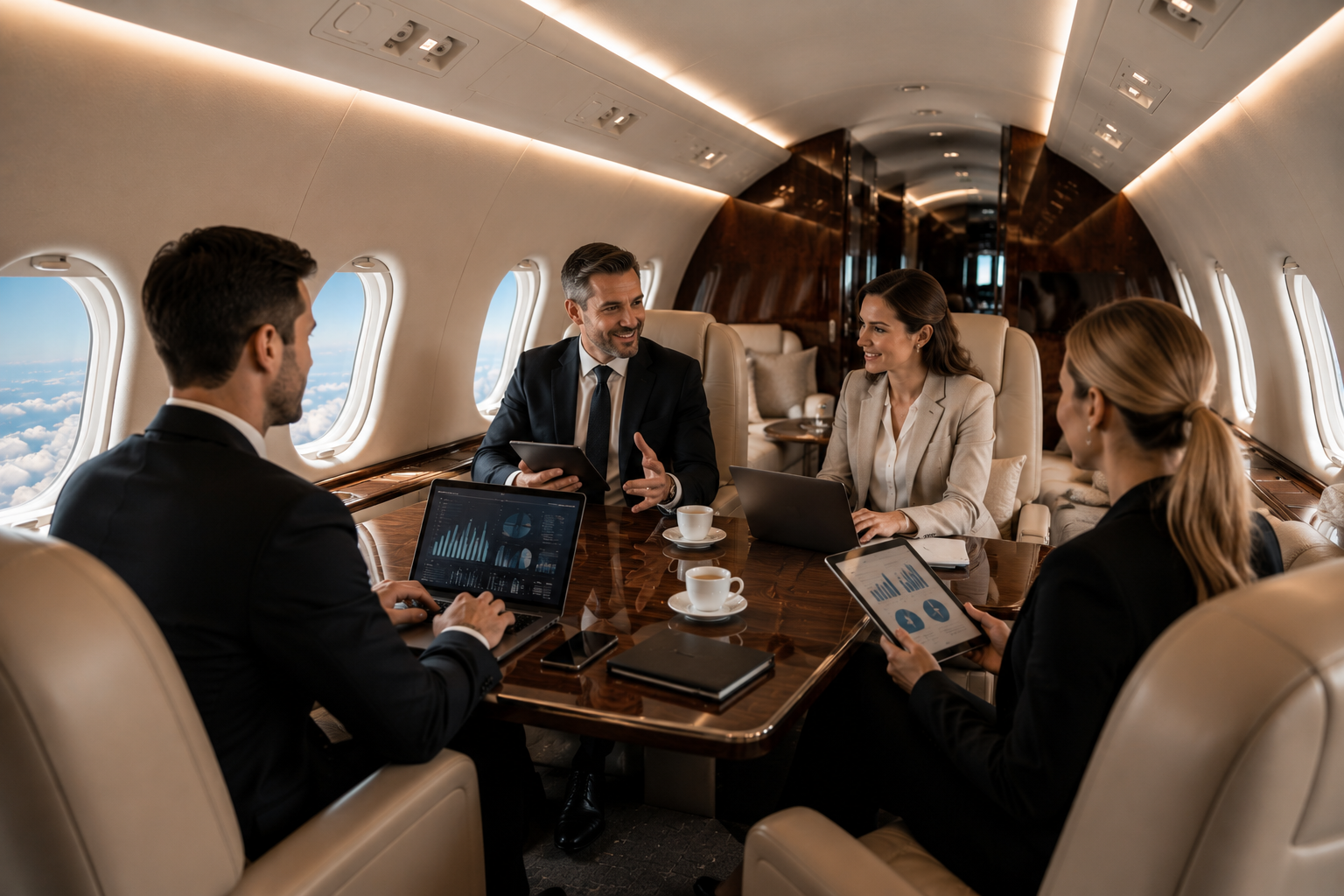
One of the most important advantages of business aviation is its ability to convert travel time into working time.
Commercial airline environments often present obstacles to meaningful productivity. Privacy limitations, noise, connectivity challenges, and restricted workspace can make it difficult to conduct sensitive business activities.
Business aircraft provide a fundamentally different environment.
Passengers can:
- Conduct confidential meetings
- Review strategic documents
- Participate in planning sessions
- Prepare presentations
- Communicate with stakeholders
- Analyze business data
Rather than interrupting work, travel becomes an opportunity to continue it.
The aircraft effectively functions as a mobile office, allowing executives and teams to remain productive throughout the journey.
For organizations operating in fast-moving industries, this continuity can create substantial competitive advantages.
The Strategic Value of Executive Time

Not all hours possess equal economic value.
The time of senior executives, entrepreneurs, and decision-makers often carries disproportionately high organizational importance. Their activities influence strategic direction, resource allocation, client relationships, and operational performance.
As a result, even modest improvements in executive efficiency can generate significant organizational benefits.
Business aviation supports this objective by minimizing non-productive travel activities and maximizing opportunities for meaningful engagement.
Instead of spending hours navigating airport procedures, executives can devote that time to:
- Revenue-generating activities
- Client interactions
- Strategic planning
- Team leadership
- Business development
The resulting productivity gains frequently extend far beyond the duration of the flight itself.
Enhancing Team Collaboration in Transit
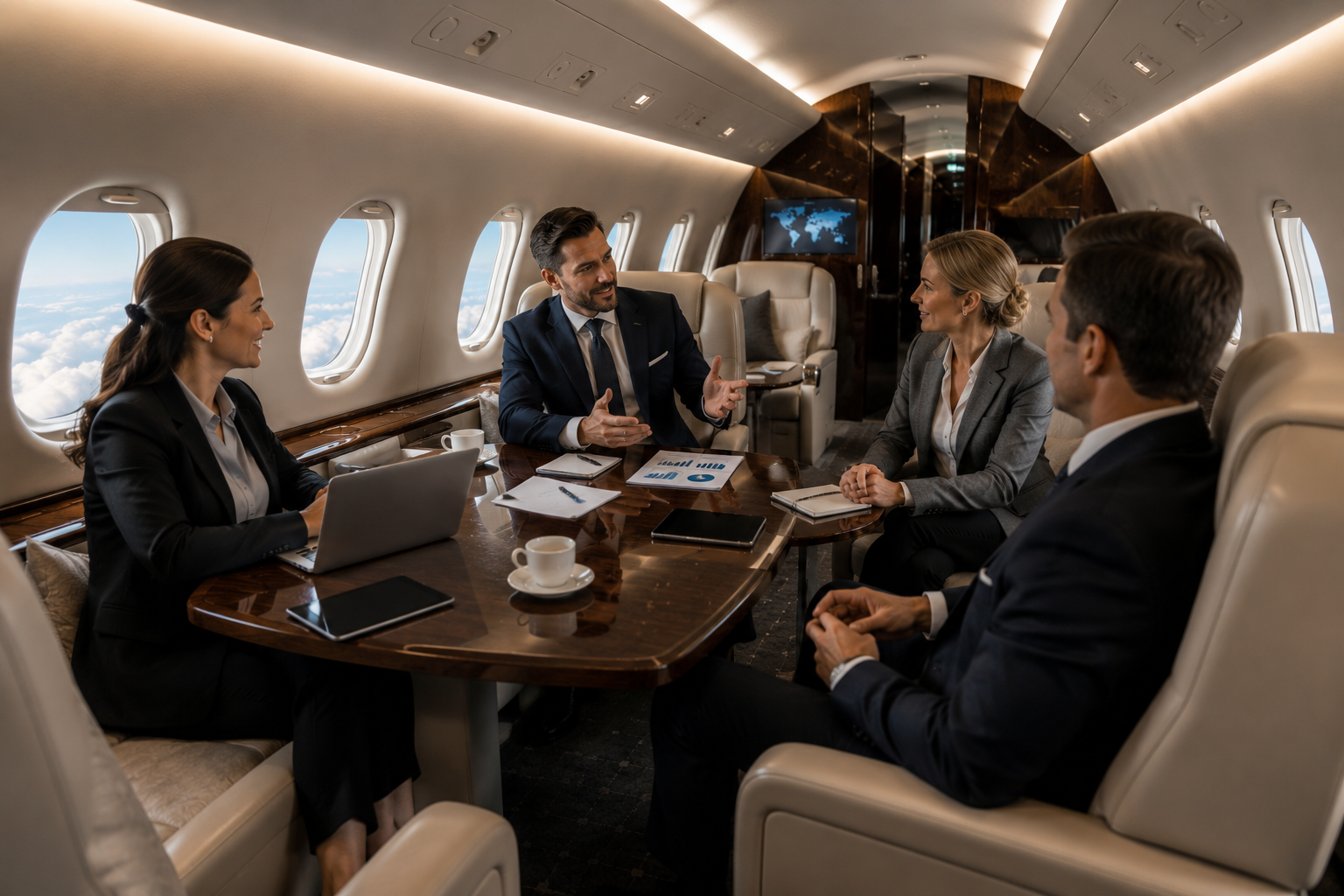
Business aviation creates unique opportunities for collaboration that are difficult to replicate through commercial travel.
When leadership teams travel together, the aircraft becomes a private environment where discussions can occur without interruption or confidentiality concerns.
This setting enables:
- Strategic planning sessions
- Project reviews
- Negotiation preparation
- Investment discussions
- Crisis management coordination
Importantly, these interactions occur during travel time that would otherwise be largely unproductive.
By transforming transit into collaboration time, organizations can accelerate decision-making processes and improve alignment among key stakeholders.
In many cases, critical decisions are reached before the aircraft even lands.
Supporting Multi-Destination Business Travel
Business aviation’s productivity advantages become particularly evident when multiple destinations must be visited within compressed timeframes.
Commercial airline networks are optimized for transporting large numbers of passengers between major cities. They are not necessarily optimized for executive efficiency.
Visiting several regional offices, manufacturing facilities, or client locations often requires:
- Multiple flight connections
- Overnight stays
- Extended layovers
- Significant scheduling complexity
Business aviation offers a more flexible alternative.
Aircraft can be routed according to specific business requirements, enabling multiple meetings across different locations within a single day.
This capability increases organizational responsiveness while reducing the time required to accomplish critical objectives.
For companies operating across broad geographic regions, these efficiencies can significantly enhance overall productivity.
Access to More Airports and More Opportunities

One of the defining characteristics of business aviation is access.
Private aircraft can operate from thousands of airports worldwide, including many regional and executive facilities unavailable to commercial airlines.
This expanded airport network creates substantial productivity benefits.
Executives can frequently land closer to:
- Client offices
- Industrial facilities
- Project sites
- Corporate headquarters
- Investment opportunities
Reduced ground transportation requirements shorten overall journey times and increase schedule flexibility.
More importantly, enhanced accessibility expands the range of opportunities that can be pursued efficiently.
Organizations are no longer constrained by the limitations of commercial route networks.
Improving Organizational Agility
Productivity is closely linked to agility.
Organizations that can respond quickly to emerging opportunities and challenges often outperform those constrained by slower decision-making processes.
Business aviation enhances organizational agility by enabling rapid mobility.
Executives can travel on short notice to:
- Meet potential clients
- Address operational issues
- Conduct due diligence
- Evaluate acquisitions
- Manage critical situations
This responsiveness allows organizations to act more decisively and maintain momentum in dynamic environments.
In many industries, speed itself represents a competitive advantage.
Reducing Travel Fatigue and Cognitive Load

Productivity is not determined solely by time availability. It is also influenced by energy, focus, and cognitive performance.
Commercial travel can be physically and mentally demanding.
Crowded airports, schedule disruptions, lengthy connections, and unpredictable travel experiences contribute to fatigue that often persists after arrival.
Business aviation reduces many of these stressors.
Travelers benefit from:
- Streamlined procedures
- Reduced waiting times
- Greater comfort
- Improved privacy
- More predictable schedules
The result is a more manageable travel experience that supports sustained performance.
Executives often arrive better prepared, more focused, and more capable of performing at a high level immediately upon arrival.
The Economic Impact of Productivity Gains

The productivity benefits of business aviation have tangible economic implications.
Organizations frequently evaluate travel expenditures as direct costs while overlooking the value generated by improved efficiency.
However, productivity gains can influence:
- Revenue generation
- Client retention
- Project execution
- Decision-making speed
- Market responsiveness
- Resource utilization
In many cases, the economic value created by these improvements exceeds the direct cost of private aviation itself.
This perspective helps explain why many organizations continue to invest in business aviation despite the availability of lower-cost transportation alternatives.
The relevant comparison is not merely the cost of travel.
It is the value of what becomes possible because travel is more efficient.
Business Aviation as a Strategic Tool

The most successful organizations rarely view business aviation as a luxury service.
Instead, they regard it as a strategic tool that supports broader business objectives.
Its value lies in enabling:
- Faster decision-making
- Greater mobility
- Enhanced productivity
- Improved collaboration
- Stronger client engagement
- Increased operational flexibility
When integrated effectively into an organization’s mobility strategy, business aviation becomes an enabler of growth rather than simply a means of transportation.
This distinction is critical.
The aircraft itself is not the source of value. The value emerges from the productivity, efficiency, and opportunities that the aircraft makes possible.
Measuring Productivity Beyond Flight Hours

Traditional travel metrics often focus on flight duration, cost per hour, or miles traveled.
While useful, these measurements fail to capture business aviation’s most significant contribution.
A more meaningful evaluation considers questions such as:
- How much executive time was preserved?
- How many additional meetings were conducted?
- How quickly were decisions made?
- How much travel-related downtime was eliminated?
- How effectively were teams able to collaborate?
These outcomes provide a more comprehensive understanding of productivity and its relationship to mobility.
Organizations that evaluate travel through this lens often discover that business aviation delivers value far beyond transportation efficiency alone.
Productivity as the Defining Advantage of Business Aviation

Business aviation undoubtedly offers comfort, privacy, and convenience. Yet these attributes are secondary to its most important contribution.
Its defining advantage is productivity.
By reducing travel inefficiencies, preserving executive time, facilitating collaboration, improving accessibility, and supporting organizational agility, business aviation transforms travel from a disruption into an opportunity.
In a business environment where speed, responsiveness, and effective decision-making increasingly determine success, this transformation carries significant strategic value.

The organizations that recognize this reality understand that business aviation is not simply about reaching destinations more comfortably. It is about enabling people to accomplish more before, during, and after every journey.
For companies committed to maximizing the value of their most important resource—their people—the productivity advantage of business aviation remains one of the strongest and most enduring arguments for private flight.